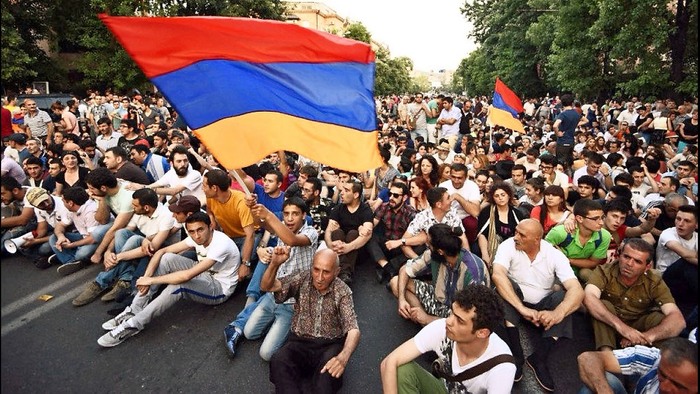
Political scientist Gwendolyn Sasse (ZOIS director) and Nadia Douglas (ZOIS researcher) discussed the precursors of the protests, their key success factors and the reform process initiated by Pashinyan's government with the journalist and Caucasus expert Silvia Stöber. The interview is freely available on the website of the Berlin Center for East European and International Studies. During the 42-minute conversation, the experts analyzed the progress of the 2018 protests in detail, focusing on the socio-economic background of the protest movement and the tactics of the demonstrators, which led to the success of the Armenian revolution and Pashinyan's rise to become the leader of the protest movement.
Regarding the foreign policy outcomes and perspectives of the Velvet Revolution, ZOIS researcher Nadja Douglas suggested that Yerevan's foreign policy would not change significantly under the new leadership. "With regard to Russia, the Pashinyan government will prefer a policy of continuity. However, I think that Armenia will continue to be constructively engaged in the context of the CEPA agreement with the EU, but I do not think there will be any progress in the foreseeable future towards an association agreement with the EU, "she said. According to Douglas, this is because the Armenian people want to maintain equally good relations with the EU and the Eurasian Economic Union. "In that sense, I do not think Armenia will move in one direction or the other in the near future. And despite everything, I believe that the Pashinyan government will see the normalization of relations with Azerbaijan as an important issue. Surveys show that right after the problems of unemployment and the socio-economic questions, the Nagorno-Karabakh conflict is repeatedly named as a major obstacle for the peace, stability and national security of Armenia. Unlike other conflicts in the region, such as in Georgia or Moldova, the conflict in Nagorno-Karabakh is not a frozen conflict, and that is something that every Armenian is aware of, "says the ZOIS research associate.
Journalist Silvia Stöber talked about the connection between the April skirmishes in 2016 in Nagorno-Karabakh and the Armenian "Velvet Revolution" in April 2018. "During the 4-day war in 2016 in Nagorno-Karabakh, Azerbaijan was able to take a piece of territory. There were casualties, many died on the Armenian side, killed by Russian weapons - that is, weapons that Russia had supplied to Azerbaijan. This caused great anger in the [Armenian] population. The Armenian government was accused of not being able to defend the territory. Secondly, not to have prevented Russia from selling weapons to Azerbaijan. And then there was the aspect of corruption, as the soldiers were not being supplied in a manner that would have enabled them to fight sufficiently. This made a difference in terms of credibility loss and popular dissatisfaction, "said Stöber. She added that even the Republican Party's argument, which relied heavily on domestic stability and the warning that destabilization in Armenia would be exploited by Azerbaijan, had not come true. According to the journalist, Pashinyan's political leverage regarding the Nagorno-Karabakh issue is limited today, forcing him to adopt even tougher stances than his predecessors of the Republican Party did.