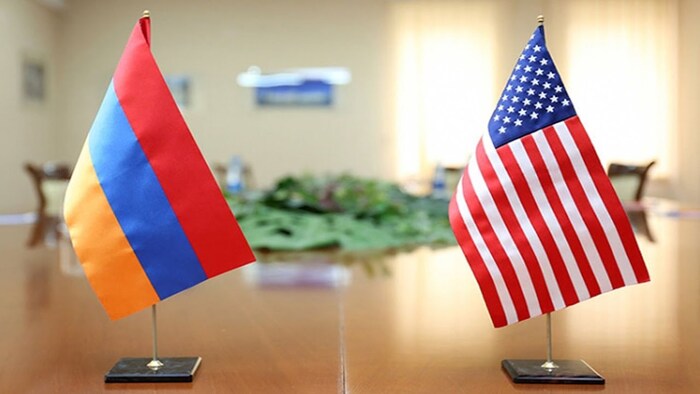
On 15 May, the US ambassador to Armenia, Lynn Tracy, held a speech in front of the members of the American Chamber of Commerce in Armenia (AmCham). She reflected on the changes in Armenia after the Velvet Revolution, the US-Armenian relations, the Nagorno-Karabakh negotiations, as well as her perception of Armenia’s relations to Russia and Iran.
According to Tracy, Armenia has become more democratic than ever since the Velvet Revolution. Of special praise were the elections that were held in December, which were categorized as “free, fair and democratic”.
The fight against corruption has been highlighted as the biggest milestone of the Pashinyan government. “I am especially encouraged by the government’s efforts to root out corruption and promote transparency. This will help level the playing field and signal to the international community that Armenia is a country that respects the rule of law and is open for business. This is particularly important given the strong potential for an improved U.S.-Armenian economic relationship”, said Tracy.
Tracy also touched on the topic of US financial assistance to Armenia, as a response to Pashinyan’s criticism in March that there has been no significant increase in U.S. economic assistance to Yerevan since the revolution. Tracy countered that allegation with the fact that in 2018 the United States provided $26.7 million in assistance to Armenia in addition to an ongoing $66 million aid program implemented by the U.S. Agency for International Development (USAID). U.S. assistance to Armenia has totaled over $2 billion since 1992, and she also confirmed that Washington will allocate up to $16 million in fresh aid to Yerevan this year.
Tracy was also confronted with the question on how she perceives Armenia’s relations to Russia and Iran, considering that the United States do not harbor friendly relations with these two countries. “We understand that as a reality of geography and history Armenia maintains strong ties to Russia, but I think most Armenians agree with me that the Armenian-Russian relationship should not and does not preclude Armenia from also pursuing strong, mutually beneficial relations with the United States, the European Union, and other partners”, replied Tracy. She as well does not see any obstacles in regard to Armenia’s relations to Iran. “We are not asking Armenia to cut off its trade with Iran. We have no interest in interfering with legitimate trade between this nation and her very important neighbor”, she said.
Tracy said that although Washington and Yerevan “do not agree on everything” they deal with issues of mutual interest through an “open and honest dialogue.” She also praised Armenia’s continuing participation in the NATO-led missions in Afghanistan and Kosovo.
The last topic which was touched upon were the ongoing negotiations on the Nagorno-Karabakh conflict. Tracy made it clear that the US is working together with Russia and France within the Minsk-group in order to broker a peaceful settlement to the conflict. “It has been a long road and there are no easy solutions. But the events of recent months have led me to believe that progress is possible”, she concluded.