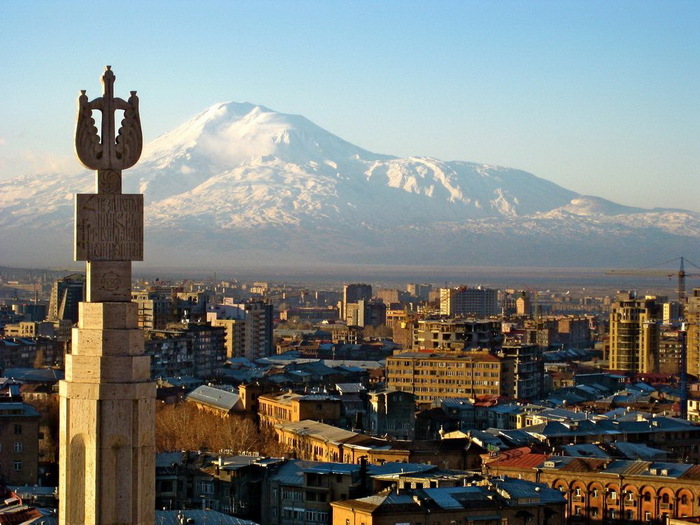
On 10 April, the Armenian government declared it will extend the state of emergency by one month in order to try to slow the spread of coronavirus in the country, reported the Armenian Radio Free Europe. The state of emergency will thus be extended until 14 May.
A draft of the government’s decision was leaked to the Armenian press. It stated that the coronavirus cases in the country are continuing to increase even though the rate of new infections has slowed thanks to the serious restrictions on people’s movement and the closure of many businesses. Armenia’s Health Minister Arsen Torosyan sounded a note of caution over the decreased in infection, saying that the epidemic is not yet ending and requires continued “harsh” measures by the authorities.
“We cannot reckon that the spread is stopping or dying down by 100 percent. Why? Because while we previously had 50 cases a day, they typically originated from a single source: for example, 50 employees of a large manufacturing plant. Now we are having 16, 20 or 30 cases a day but from 10 or 20 different sources. This is making it harder for the authorities to identify and isolate people who have been in contact with known COVID-19 patients,” he said.
“We must do these actions as long as we have the strength. The answer is approximately the following: when the country no longer has strength, then we will [end] some actions, leave only testing and treatment, we will no longer isolate, because it will be pointless, the distribution will be very large” he added.
Despite prolonging the state of emergency, the Armenian government decided to ease the restrictions on some economic sectors in the country. Armenia’s Prime Minister Nikol Pashinyan named the types of economic activity that will be allowed starting from 13 April. The sectors are agriculture, forestry, fishing, mining, supply of electricity, gas, steam, water, wastewater and waste management and processing and freight and warehousing. Other sectors given the “go ahead” are financial activities and insurance, public administration and defense, social security protection, healthcare and activities of foreign organizations. The ban on construction and production of tobacco products will also be lifted. After 20 April, the activities of hardware stores, research and development, clothing production and the textile industry would also be allowed.
Pashinyan was the most cautious with the lifting of economic activities in the manufacturing sector, as it entailed the most risks for the spread of the virus. “For us the riskiest sector here is textile manufacturing because, as you know, it has been the main driving force of about 1,000 coronavirus cases that we have now. But we also realize that people need to work, and we will hold more detailed discussions with textile industry entrepreneurs … so that they can organize manufacturing as safely as possible,” he stated.
He also warned that the government will restore the initial restrictions on economic activity if there is a renewed upsurge in infection rates. “The fact that we have a relatively small number of infections and are reopening more areas of economic activity doesn’t mean that our epidemiological situation has improved. No, our epidemiological situation has stabilized but not improved,” he concluded.
The current tally of infected persons in the country stands at 1,039, with 14 reported deaths.