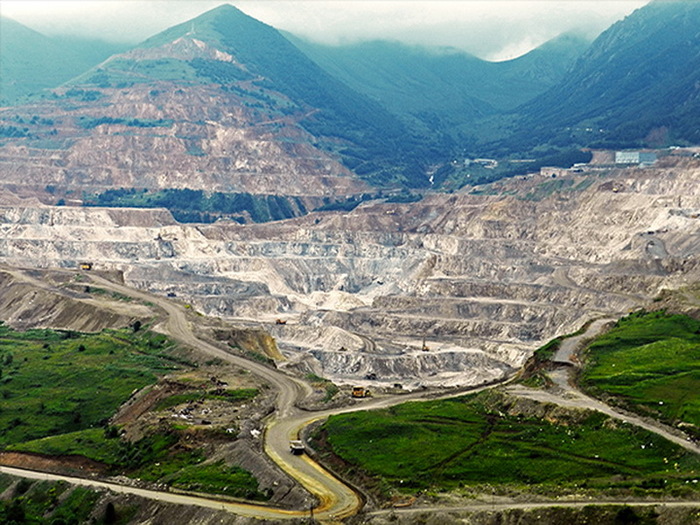
On 12 August, Open Democracy reported that the European Bank for Reconstruction and Development (EBRD) investment in the controversial $400m Amulsar gold mine project in Armenia will end.
In an assessment report by the EBRD’s Independent Project Assessment Mechanism (IPAM), published on 7 August, it was stated that the bank’s investment will be “terminated” as part of Lydian’s corporate restructuring process.
The EBRD IPAM report came as a response to a complaint by residents of the local tourist town of Jermuk, as well as five non-governmental organisations in May this year. They claimed that Lydian had “failed to ensure that the project complies with the requirements of the bank’s Environmental and Social Policy,” and that they had “already experienced serious environmental harm from the project, resulting from pollution of water, air and land.” The EBRD stated in response to the complaint that “environmental and social due diligence on the Project was undertaken and that the issues presented in the Request had been adequately addressed by the Company.” The report did not state Lydian’s position on the specifics of the complaint, but that the company “had indicated their willingness… to move discussions with stakeholders forward and with the intent of resolving issues.”
In its summation, IPAM stated that “problem solving would offer limited potential for a constructive dialogue… due to the lack of trust between the Parties,” and that the “Parties share irreconcilable differences in their own principles.”
“The EBRD owes the public a proper statement expressing its position on the project and current developments. The recent despicable provocation by Lydian’s security company at Amulsar is only a sign of the reputational damage that this investment will continue to inflict on the EBRD, even after its shareholdings in Lydian International are wound up,” said Fidanka McGrath, EBRD policy officer at CEE Bankwatch Network.
“The EBRD can still redeem itself by speaking up in support of democracy and by working with the Armenian government to remedy the environmental harm and social conflicts caused by the project. Either way the bank will have to answer for its failure to ensure proper consultations with affected communities,” she added.
Lydian responded quickly to the Open Democracy publication, countering the presented information. “Let's start with the fact that the EBRD has not stopped investing, whereas Fidanka McGrath, who is quoted in the statement issued in this regard, is not an EBRD representative, but a member of an environmental NGO. The EBRD and other shareholders have ceased to be part of the Amulsar project solely as a result of continued lawlessness in Armenia, and on this occasion, the joy of those who disseminated this news is incomprehensible. Lydian will also continue to discuss the scope of further cooperation with the EBRD on the Amulsar project,” the statement read.
To note, the EBRD has funded exploration, drilling and feasibility studies and environmental and social mitigation measures by Lydian since 2009, and has been targeted with criticism by civil society groups over its support for Lydian numerous times.