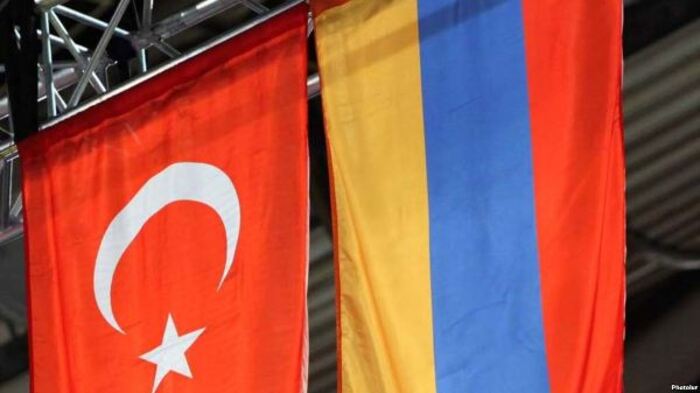
Turkey and Armenia have agreed to establish special envoys to repair bilateral relations.
"We and Armenia will soon appoint special envoys to take steps toward the normalisation” of bilateral relations, Turkish Foreign Minister Çavuşoğlu said on December 13. "We will also open chartered flights with the Armenian capital city Yerevan.”
Vahan Hunanyan, a spokesman for Armenia’s Foreign Ministry, confirmed Çavuşoğlu’s announcement.
"In this regard, we positively assess the statement of the Turkish Foreign Minister on the appointment of a special representative for the normalisation of relations, and confirm that the Armenian side will appoint a special representative for this dialogue," Hunanyan said in a December 14 statement.
Çavuşoğlu also stated that Turkey will take each step in conjunction with Azerbaijan, which has indicated that it expects to attempt to have some of its interests considered while Ankara's allies pursue a deal with Yerevan.
Hunanyan stated that Armenia is willing to normalise relations "without restrictions."
When Turkey unilaterally closed the border in reaction to Armenians capturing land surrounding Nagorno-Karabakh during the first conflict between Armenia and Azerbaijan in 1993, formal links were broken. The two nations attempted to re-establish connections for the first time in 2009, with American and Swiss mediation, but the endeavour failed owing to Azerbaijan's obstinacy.
In November, Russian Foreign Ministry spokeswoman Maria Zakharova said Moscow was willing to arbitrate between Ankara and Yerevan, adding that normalisation "would surely help to the improvement of the overall situation in the area."
The United States has also been a driving force behind the endeavour. President Joe Biden pushed his Turkish counterpart, Recep Tayyip Erdoğan, to open the border with Armenia at a visit in Rome in October, Bloomberg reported, citing an anonymous "senior Turkish official."
Officials from the government have stressed the benefits that mending relations may offer.
"It is about starting diplomatic relations between Armenia and Turkey. This doesn't mean that Armenia is giving up its key state interests,” said Eduard Aghajanyan, a member of parliament from the ruling Civil Contract party, told journalists. “On the contrary, we are convinced that Armenia's state interest is to establish diplomatic relations with Turkey. There is simply no alternative but to establish good neighbourly relations with neighbouring countries."
Despite high-level attempts toward reconciliation, relations have remained largely icy. Armenia's parliament is debating whether to extend a ban on Turkish imports imposed during last year's fighting. After Ankara stopped Armenian planes in August 2020, Turkish airspace remained inaccessible to them.