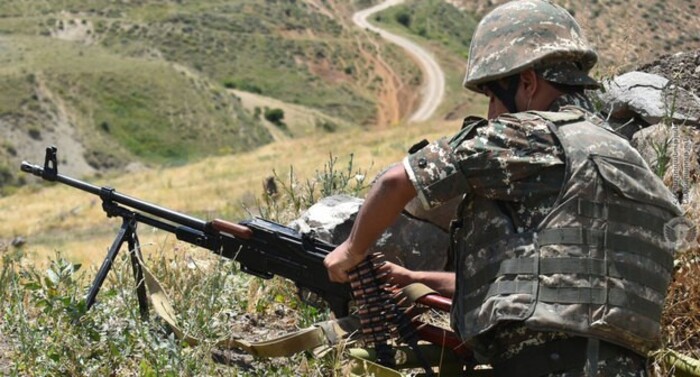
In the latest incident following a 2020 war between the ex-Soviet foes, Azerbaijan and Armenia reported fighting on their dangerous border, killing one Azeri soldier and three Armenian soldiers.
The Azerbaijani soldier died as a consequence of a "provocation" by Armenian armed forces, according to Azerbaijan's defence ministry, and "the responsibility for tension belongs with Armenia's military-political leadership."
Following the incident in the border area of Kalbajar, the ministry announced its personnel had "suppressed" the enemy.
Three Armenian soldiers were also killed, according to Armenia, which condemned the Azerbaijani army's "provocative actions." Azerbaijan has used drones and artillery against Armenian forces in a location on the country's eastern border, according to Yerevan.
The Armenian military fired on Azerbaijani positions with small arms and large-calibre machine guns' between the night of 11 January and the morning of 12 January, according to the latest statement from the Azerbaijani Defence Ministry, issued on 12 January. There were no further deaths or injuries recorded.
The Azerbaijani military shot at “civilians and civilian objects” in the Martuni (Khojavend) district on January 10, according to officials in Nagorno-Karabakh.
The Kalbajar area was handed up to Azerbaijan as part of a ceasefire mediated by Moscow.
The fatality comes after de-facto Nagorno-Karabakh leadership claimed earlier this week that Azerbaijani soldiers opened fire near a school, causing a car to be damaged.
Defence officials in separatist Nagorno-Karabakh said Russian peacekeepers deployed to the disputed mountainous region had been alerted to the firing, which Azerbaijan’s defence ministry denied had taken place.
OSCE calls on Armenia and Azerbaijan to start meaningful dialogue
The Organization for Security and Cooperation in Europe (OSCE) called on Armenia and Azerbaijan to start a meaningful dialogue. This was announced on January 12 by the press secretary of the OSCE Chairman-in-Office Zbigniew Rau, Second Secretary of the Polish Permanent Mission to the organisation Bartosz Kempinski.
"We are closely following the situation in the South Caucasus. We call on Azerbaijan and Armenia to refrain from using force and start a meaningful dialogue to resolve the dispute over Nagorno-Karabakh," he said.
Kempinski also added that Poland, as the OSCE Chairman-in-Office, intends to work with partners to renew and strengthen its efforts "to ensure peace and sustainable development in the region."
In addition, the Polish representative noted that he supports the efforts of the OSCE Minsk Group co-chairs for the settlement in Nagorno-Karabakh.
On January 10, Russian and Armenian Defence Ministers Sergei Shoigu and Suren Papikyan had telephone call on the situation in Kazakhstan and discussed the activities of the CSTO peacekeeping forces in the Central Asian country.