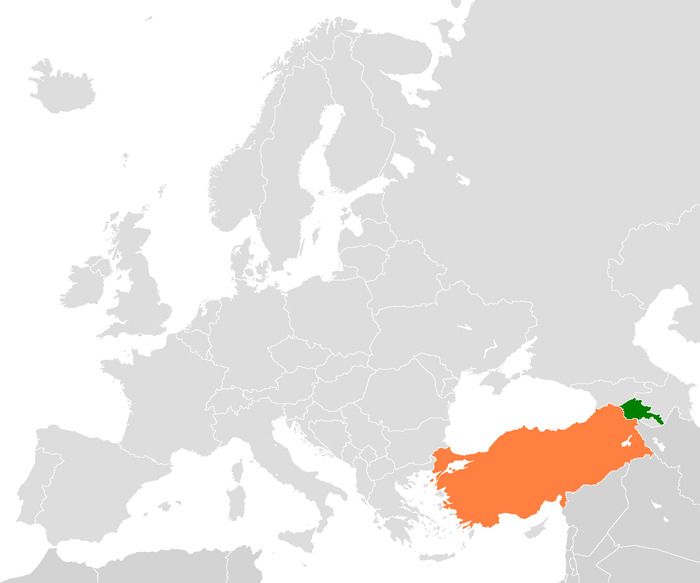
On January 14, the envoys — Serdar Kılıç, a prominent Turkish official, and Ruben Rubinyan, Armenia's deputy speaker - met in Moscow. Following the discussion, all parties issued similar statements that were favourably phrased.
“During their first meeting, conducted in a positive and constructive atmosphere, the Special Representatives exchanged their preliminary views regarding the normalisation process through dialogue between Armenia and Turkey,” the two foreign ministries said. “Parties agreed to continue negotiations without preconditions aiming at full normalisation.” The meeting was not filmed and afterwards, the envoys did not speak to the press.
The envoys were chosen in December as part of their nations' efforts to repair ties in the aftermath of Armenia's and Azerbaijan's conflict in 2020.
“With that issue off the table, Turkey began to signal its readiness for new talks with Armenia soon after the war,” the International Crisis Group wrote in an analysis previewing the January 14 talks.
“Having long posed the greatest impediment to a Turkish-Armenian rapprochement, Baku’s public and private tone has changed dramatically in the wake of its victory,” the Crisis Group analysts wrote. “Some senior bureaucrats in Baku privately suggest that Turkish-Armenian normalisation might even help smooth their own post-war relations with Armenia by showing the benefits of shifting from a war footing to an everyone-wins focus on trade.”
Earlier, Baku "completely supported" Armenia and Turkey's rapprochement efforts, according to Azerbaijani Foreign Minister Jeyhun Bayramov.
The talks with Armenia, according to foreign policy commentator Tahla Köse of the Turkish pro-government newspaper Daily Sabah, are part of a larger effort by Ankara to improve many of its strained relations in the region, including those with the United Arab Emirates, Egypt, Saudi Arabia, and Israel.
Moreover, in an interview, Farid Shafiyev, the chairman of an Azerbaijani government-run foreign policy think tank, claimed Baku and Yerevan had struck a verbal agreement to establish a boundary delineation committee.
Russian Foreign Minister Sergey Lavrov, at a press conference the morning before the Kılıç-Rubinyan meeting, said that Armenia and Azerbaijan were close to reaching an agreement on one of the key issues in their bilateral agenda: the demarcation of the two countries’ border. “Literally yesterday (13 December) I was speaking with an Armenian colleague, who had a new proposal, we will send it along to Azerbaijan. We will see how to make (an Armenia-Azerbaijan-Russia commission working on border issues) work it out as quickly as possible.”