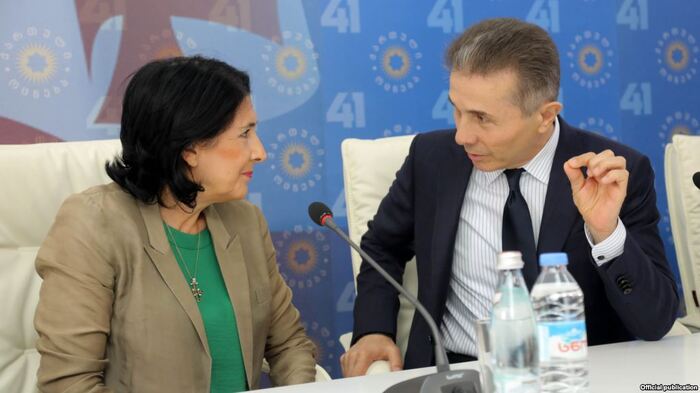
Georgia's presidential election took place on 28 October, the results of which are anything but positive for the current Georgian government. Salome Zurabishvili, the formally independent candidate, who had been strongly supported by the chairman of the governing party "Georgian Dream" (GD), Bidsina Ivanishvili, showed a surprisingly weak result of 38.66%. Her main political opponent, Grigol Vashadze of the UNM, got 37.7%. He was followed by the candidate of "European Georgia", Davit Bakradse, with 10.97%.
Thus, despite the expectations of many analysts and the forecast of an exit poll survey ordered by the GD, Zurabishvili could not win the election in the first round. Whether she will succeed in the second round of the election, which will take place until 2 December, is highly questionable. This is because Bakradse, the third strongest candidate, has already called on his supporters to give their votes to Grigol Vashadze for the second round of the election. In addition, the opposition is on the upswing after the strong result of Vashadze.
The Georgian political scientist Georgi Nodia believes that the results of the first round of the election increased the chances of Vashadze to win in the second round of the election. "The myth that the governing party is too strong and invincible has been torn apart," says Nodia. In addition, the power relations within the opposition have now been clarified, as the election has shown that there is a much higher level of support for Vashadze than for Baktadze.
The weak election performance of Salome Zurabishvili could be explained by several factors.
First, the Georgian people could have used the presidential election to show their dissatisfaction with the work of the government, even if the presidency in Georgia is of more symbolic than political value.
Second, the presidential candidate, who comes from France and does not speak the Georgian language well, was not considered the best choice from the beginning. Yet, Surabishvili was a personal favorite of Bidzina Ivanishvili, but even in the Georgian Dream Party, not everyone agreed with supporting an independent candidate.
Third, Salome Zurabishvili caused much displeasure with her awkward remarks on the August war with Russia in 2008, which in fact blamed Georgia for the outbreak of the war. This is in line with Russia's official position.
Fourth, during the heated debates on the "Cannabis Cultivation Act", she got herself into a confrontation with the Georgian Orthodox Church, which has traditionally had tremendous influence and popularity in Georgia. Thereafter, several influential Georgian clerics clearly opposed the presidential candidate.
Fifth, the serious allegations against the Georgian judicial authorities (Subeliani case) and Bidzina Ivanishvili (Omega case) may have damaged the general reputation of the ruling party among the population.