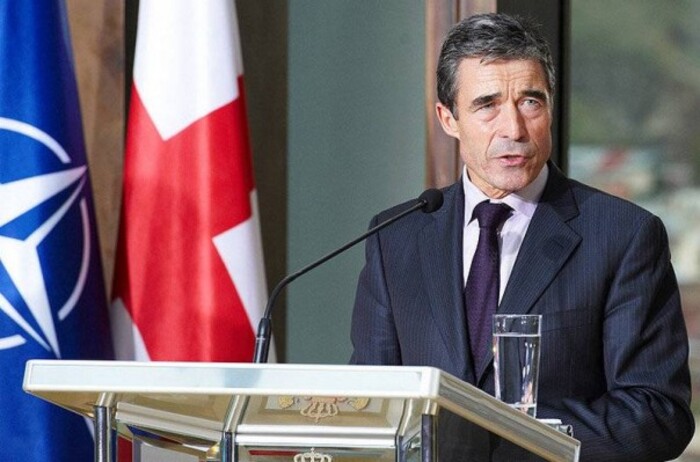
On 9-10 September, the 5th Tbilisi International Conference, organized by the McCain Institute for International Leadership and the Economic Policy Research Center (EPRC) took place. Amongst the prominent guests of the conference was Anders Fogh Rasmussen, former Secretary-General of NATO, who shared his thoughts on Georgia’s potential to become a member of the alliance.
At the panel, Rasmussen highlighted Georgia’s importance in the eyes of the United States and the European Union, by stressing its role as an energy corridor. “From a strategic point of view, Georgia has a very important location in terms of energy, energy pipelines. This is an important corridor for Russia and Europe, and it is very important for us that Georgia continues its path on reforms and its aspiration to join the European Union and NATO,” he said.
He then continued by evaluating current developments in Georgia. “I think Georgia has gone a long way and achieved great results. When it comes to the military, you have demonstrated the ability to meet NATO standards. However, of course, you have also expanded the scope of the reforms, strengthen the fight against corruption, it is about guaranteeing the rule of law, etc. You have to keep going on this way,” he elaborated.
Afterwards, Rasmussen gave an interesting proposal on how Georgia could become a member of NATO aside from having territorial issues with Abkhazia and Tskhinvali (South Ossetia) being currently occupied by Russia. “I think this issue should be discussed internally in Georgia, would you, in this case, be willing to accept such mechanism, according to which Article 5 of NATO will only cover the territory which is actually controlled by the Government of Georgia. And in NATO we have to reflect exactly the same question,” he said, drawing parallels to the case of Germany’s ascension in the alliance prior to the unification.
Besides Rasmussen’s proposal, the conference in Tbilisi witnessed another interesting scene, as a panel discussion was interrupted. The panel, titled “Where is Russia Going?” which was supposed to discuss issues of violation of human rights and international law by Russia, with a special focus on Georgia, was interrupted by Irma Inashvili, Deputy Chairperson at the Parliament of Georgia and representative of the pro-Russian party “Patriots of Georgia”. “I have come to brief the attendees about the party and our goals. I was not invited. However, I am vice speaker of the Georgian parliament and have the right to attend the event and deliver a speech,” Inashvili said. A verbal dispute took place between Inashvili and David Kramer, the former assistant secretary of state and a researcher of Florida University, who urged Inashvili to leave the conference.
The McCain Institute for International Leadership is a Washington, D.C.-based think tank in cooperation with Arizona State University whose mission is to "advance leadership based on security, economic opportunity, freedom, and human dignity, in the United States and around the world. The institute was formed in 2012 and is named after U.S. Senator and 2008 Republican Party presidential nominee John McCain.