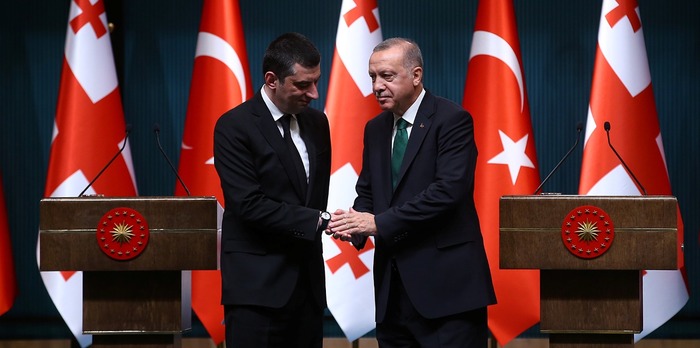
On 31 October, Georgian Prime Minister Giorgi Gakharia visited Turkey and was accompanied by Georgia’s Foreign Minister David Zalkaliani, Economy Minister Natia Turnava and his advisor for foreign affairs Irakli Chikovani.
During the trip, he met with Turkish President Recep Tayyip Erdogan. Erdogan and Gakharia discussed joint economic projects and cooperation in the logistics and energy fields, as well as the issue of Black Sea security.
Gakharia stated that Georgia has “close, brotherly ties,” and a “strategic partnership” with Turkey. “I [want to let Turkey know] that the Government of Georgia will spare no efforts to further deepen this strategic partnership and to move it to a new, efficient level,” he said. He also noted that Georgia is “very well aware and appreciates Turkey’s role in [ensuring] Black Sea security, as well as in a wider regional context.” Gakharia also confirmed that Turkey is Georgia's largest trade partner but added that it is “not enough” and the two states can “double the trade turnover in the next few years.”
Erdogan said that he and Gakharia expressed the will to further strengthen trade and economic cooperation. “Today, we once again express our will to boost our trade turnover from 1.5 billion to 3 billion USD,” he said. He also stated that the scheduled meetings of the Turkey-Georgia Economic Council (which was not been held since 2005) and the Strategic Partnership Council later this year will further this goal. Erdogan also stated that Turkey-Georgia-Azerbaijan energy and transport projects “have led to the creation of a belt of stability from the Caucasus to Anatolia.” He stated that the Baku-Tbilisi-Ceyhan, Baku-Tbilisi-Erzurum Natural Gas Pipelines and the Trans-Anatolian Natural Gas Pipeline “have turned the region into an energy hub.”
Turkey’s relations with Georgia are at strategic level. Turkey has been Georgia’s biggest trade partner since 2007 and is among the leading investing countries in Georgia. In accordance with the protocol signed on 31 May 2011, which entered into force on 10 December 2011, Turkish and Georgian citizens are able to travel each other’s country with only their national identity documents. With the aim of further developing bilateral relations, the High Level Strategic Cooperation Council (HLSC) mechanism was established. The first round of HLSC meeting was held in Ankara on 19 July 2016 and the second round of HLSC was held in Tbilisi on 23 May 2017. Turkey strongly supports Georgian territorial integrity and does not recognize the so-called independence of Abkhazia and South Ossetia. Turkey hopes that these conflicts will be resolved within Georgia's territorial integrity and sovereignty through peaceful means. Turkey also supports Georgia's efforts for integration with Euro-Atlantic organizations. Another important issue on the bilateral agenda is the return process of Ahıska Turks to their homeland. Turkey closely follows this issue and wishes that all obstacles in the return process will be eliminated in line with the obligations that Georgia assumed while being a member to the Council of Europe in 1999.