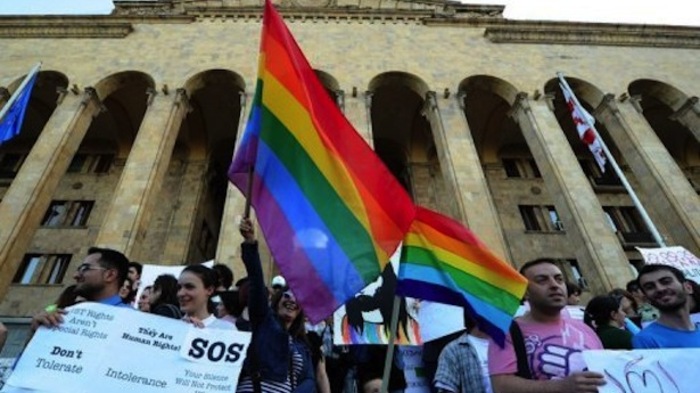
On 8 November, the Swedish-Georgian movie “And Then We Danced” starring a homosexual protagonist premiered in the Georgian cinemas in Tbilisi and Batumi resulting in a scuffle between Georgian police and radical right-wing groups which opposed the movie’s screening in the country.
The protesters were led by the Head of the Children Protection Public Movement Levan Palavandishvili, businessman Levan Vasadze, and former Deputy Minister for Diaspora Issues Sandro Bregadze. They gathered in front of Amirani Cinema in the Georgian capital of Tbilisi, stoping people from entering and watch the film. Bregadze said prior to launching the march that they were against “screening a gay-propaganda film.” Another leader of the protesters, Konstantine Morgoshia said that their key goal was not to allow film screening or at least to protest it, so that “entire Georgia sees that 100-200 bastards do not represent Georgia.”
The Georgian Patriarchate also said that it was against the screening of the film, but added that the “church distances itself from any violence.”
The protesters gathered outside the Amirani Cinema in Tbilisi and have verbally harassed and in several cases assaulted the people who went to see the movie. The Georgian Interior Ministry also reported that pyrotechnics were also used in front of the cinema. 27 people were detained in total (24 in Tbilisi and 3 in Batumi) and one more was arrested and charged under article 126 (violence) of the criminal code of Georgia for the attack against civic activist Ana Subeliani who was hospitalized with a trauma to her head. Davit Berdzenishvili, the leader of the Republican Party, who came out in solidarity with moviegoers, also was a target of the protesters attack.
The Georgian National Film Centre expressed its concerns regarding the statements of the protesters against the premiere, expressing its “full support” to the film crew and the cinemas. “The Georgian constitution guarantees the freedom of creativity. Any involvement or censorship in the creative process is absolutely unacceptable,” read the statement. The film director Levan Akin said that it was “absurd that people who bought tickets need to be brave and risk getting harassed or even assaulted just for going to see a film. I made this film with love and compassion,” he stated. Georgian Public Defender Nino Lomjaria also said that every individual was free in their decision of what to watch, condemning the protests.