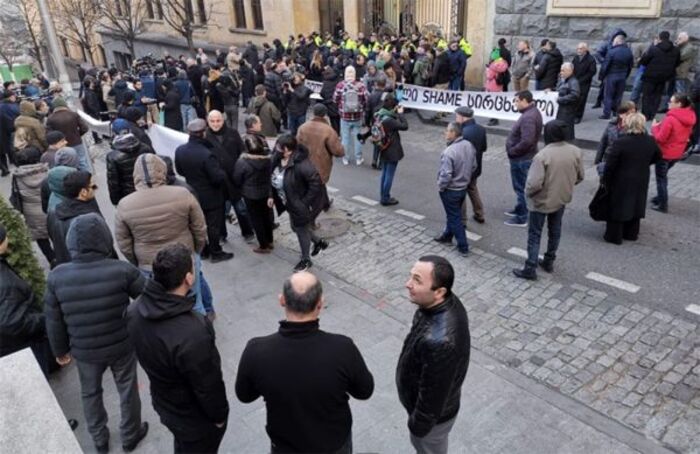
On 5 February, the Georgian opposition political parties and civil activists were holding a protest rally in front of Parliament in Tbilisi, reported georgiatoday.
The protesters, demanding the promised proportional electoral system, arranged a "corridor of shame" for the ruling party 'Georgian Dream' lawmakers. The parliamentary majority members had to enter the building through the "corridor," while demonstrators shouted 'slaves' and other words at them.
There was also a physical confrontation between law enforcers and protesters at the entrance to the parliament building after a representative of the civil movement „Change“ tried to padlock the Parliament’s gate, however, police officers did not allow him to do it.
The protest was scheduled to take place a day earlier, but was cancelled due to a tragic accident in the country, where a fire which broke out in a house in Baghdadi, killing six people, including four children.
On 3 February, the opposition parties in Georgia announced their plan B if the upcoming elections are held per the mixed electoral system. The leader of the European Georgia opposition party Sergi Kapanadze said that that the plan B meant nominating joint opposition candidates for the majoritarian race. „If we have to do so, the ruling party will lose the elections even more sharply,” he said. The opposition believes that the current electoral system, with 73 parliamentarians elected in single-mandate constituencies and 77 based on proportional system, is more beneficial to the ruling party.
OSCE Office for Democratic Institutions and Human Rights (ODIHR) also expressed their opinion regarding the Georgian opposition’s instance to implement the proportional electoral system in 2020. According to ODIHR, international best practice recommends that key aspects of electoral legislation should not be open to amendment less than one year before an election. Also, the ODIHR said that the choice of the electoral system is a sovereign decision of the state, so long as the chosen electoral system is consistent with the state’s obligations under international law.
The head of the Center for Global Studies, Nana Devdariani, agreed that the opposition will be able to implement Plan B. “Finding a compromise is not that hard - there aren’t that many real candidates, especially since the opposition parties have de facto united. But the problem is that 32 parties gathered ten times fewer people than 'Alliance of Patriots' to the protests, so the big question is whether a single candidate can win,” she said.
“Until now, they said they will fight to the end in order to achieve fully proportional elections, and now they have decided to prepare for elections in single-mandate districts. But they know that the ruling party candidates almost always win the majority [vote],” she added.
On 14 November, the proposed bill by the ruling Georgian Dream party, which was foresaw the introduction of an proportional election system, was not adopted, sparking a political crisis in the country (Caucasus Watch reported). This move was criticized by the plawmakers in the European Parliament (Caucasus Watch reported). The ruling party and the opposition have already held four meetings mediated by diplomatic corps to reach a consensus for the upcoming elections, but it did not bear any results.