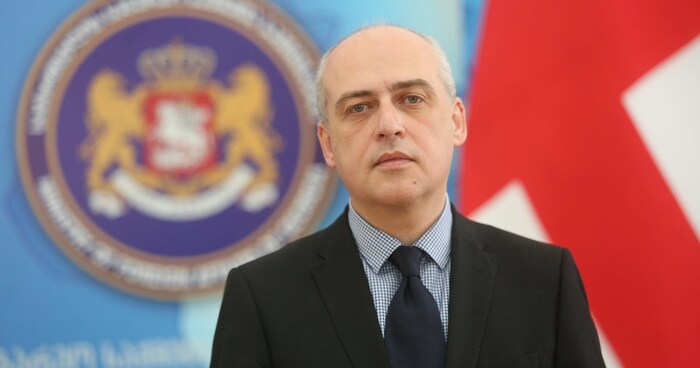
On 9 August, Georgia’s Foreign Minister David Zalkaliani presented his ministry’s 10-year action plan and his ministry’s 10 main goals which mostly focus on EU membership and de-occupation, reported agenda.ge.
Zalkaliani noted that the process of Georgia’s de-occupation must begin by 2030 and “its course should be irreversible.” He also underscored that the commission set up in late June to develop a de-occupation strategy would present Georgia's State Strategy for Deoccupation and Peaceful Conflict Resolution by the end of the year. Regarding the separatist Georgian regions of Abkhazia and Tskhinvali (South Ossetia), Zalkaliani also highlighted that it was necessary to create the possibility of political relations normalisation with Russia by adhering to de-occupation, the territorial integrity of Georgia and conflict resolution.
The EU and NATO membership of Georgia were also underscored by Zalkaliani. He stated that Georgia’s Ministry of Foreign Affairs aims to apply for membership by 2024 and receive candidate status by 2030 and to start negotiations with the EU to transpose its legislation onto Georgian legislation. He stated that the goal of getting the status of a candidate for EU membership was possible to be achieved through “the implementation of the coordinated measures, concept and action plan developed under the leadership of the [Georgian] Prime Minister [Irakli Garibashvili] within the framework of the Georgian EU Integration Commission.”
In terms of Georgia’s potential NATO membership, Zalkaliani stressed that the country’s government intends to ensure Georgia's eventual membership in NATO according to the plan developed with the Alliance. In connection with that plan, Zalkaliani noted that Georgia aims to establish a comprehensive alliance between the United States and Georgia within 10 years based on a “strong strategic partnership” which would incorporate “enhanced military-political and trade-economic components.” He also added that cooperation with the US on global challenges will be strengthened, including international health and hybrid warfare, as well as climate change and counterterrorism, cybersecurity and the introduction of 5G technologies. Besides the US, the Georgian government intends to deepen bilateral relations with Germany, France, the UK, Switzerland, Ukraine, the Nordic countries (Sweden, Denmark, Norway, and Finland), the Benelux countries (Belgium, the Netherlands, and Luxembourg), the Visegrád states (Hungary, Czech Republic, Slovakia, and Poland), Baltic countries (Lithuania, Latvia, and Estonia), as well as with the Southern and Eastern European states.
Amongst other important foreign policy goals, Zalkaliani mentioned the establishment of a “space for cooperation” in the South Caucasus by strengthening bilateral and multilateral political and economic relations with Armenia, Azerbaijan and Turkey; establishing Georgia as the regional leader with a connective function between East and West; increasing foreign investments in the country through active economic diplomacy; and establishing a strong Georgian diaspora through cultural-educational centres abroad by 2030.