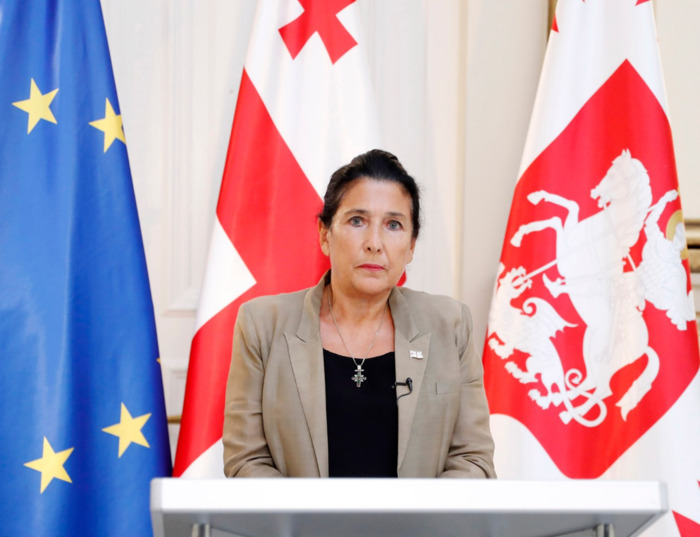
President Salome Zourabichvili of Georgia has joined a rising chorus of critics of Georgia's judiciary's alleged lack of independence.
The president described the 'time and form' of two recent nominations to the High Council of Justice (HCoJ) as "incomprehensible" in a news conference Wednesday evening, saying that it ran counter to the country's judicial reform program.
On 31 October, the council, a stand-alone agency responsible for overseeing the judiciary, elected two men, Paata Silagadze and Giorgi Goginashvili, to replace two women, Tea Leonidze and Tamar Oniani, who resigned before their tenures expired.
The replacements took place without explanation as to why the outgoing members resigned.
Following a number of Georgian watchdogs, as well as the US and EU embassies in Georgia, who pointed out that the replacements took place when the public was focused on the 30 October municipal election runoffs, the president was the latest to criticise the decision.
The embassies also stated that no information regarding the openings or the new applicants was provided until the judicial meeting on October 31st, which was used to pick them.
The Georgia Democracy Initiative (GDI), a Tbilisi-based monitoring group, highlighted that neither of the only two candidates for the positions “campaigned, delivered numerous speeches, outlined their platform, or addressed the Conference in any way.”
In separate comments, both GDI and the Georgian Young Lawyers' Association (GYLA) referred to the present HCoJ leadership as a "tribe."
The Conference of Judges, which is part of the High Council of Justice, retaliated against the president and the EU and US embassies on Thursday, calling their criticism "exaggerated, unjustified, and inconsistent," as it did in June.
The Conference of Judges, who claim to speak for over 200 Georgian judges, reminded ‘all interlocutors’ that Georgia was an ‘independent state’ and that its judiciary ‘obeyed only the law’.
Since the establishment of the HCoJ in 2017, judicial changes in Georgia have been increasingly divisive. Critics have consistently warned that the ruling Georgian Dream party is attempting to protect an influential group of justices who are thought to be loyal to the UNM-led government.
The debate erupted again in August, when Prime Minister Irakli Gharibashvili unexpectedly declared that the government would not seek €75 million from the EU's Macro-Financial Assistance program, which was contingent on Georgia pursuing changes, including those in the judiciary.
The government and opposition signed an EU-mediated agreement in April that called for the passage of law no later than the spring of 2022, reforming the composition and methods for selecting members of the HCoJ, as well as judges throughout the judicial system. A ban on the appointment of new HCoJ members and supreme court judges was included in the agreement until the changes were implemented.
Appointments proceeded in May, but Georgian Dream dropped out of the April contract in July.