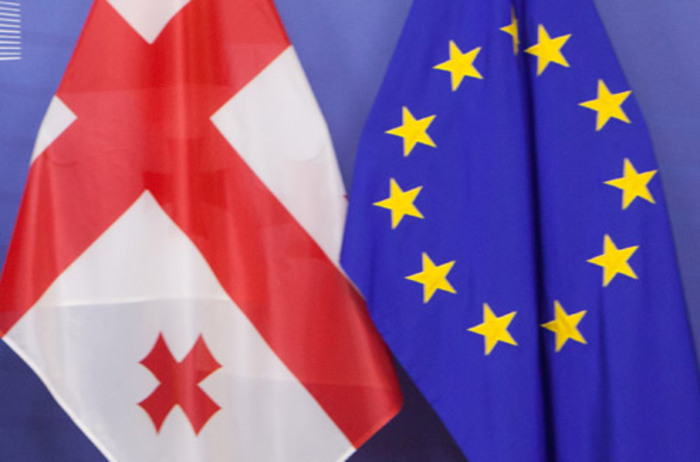
The president of the European Commission, Ursula von der Leyen, said on June 17 that the Commission recommends that Ukraine and Moldova get candidate status if they make the necessary changes. The Commission also recommends that Georgia pursue a European perspective, but it must first meet the criteria before becoming a candidate.
Irakli Kobakhidze, the chairman of the ruling Georgian Dream party, responded that the government will do all possible to further build democratic institutions, guarantee peace, and promote economic growth in order to keep the prospect of membership alive. "We are glad that this perspective has now been formally acknowledged by the European Commission and that it has provided us with a detailed roadmap to achieving candidate status," he stated.
The head of the government party emphasised that European leaders had warned that Georgia's location made it hard for it to get candidate status. He also said he was hopeful that this wouldn't be a reason for delays in giving Georgia candidate or member status in the future. Noting that candidate status does not confer any financial or other substantial advantages on the country, Kobakhidze emphasised that not acquiring the status at this time is quite frustrating for Georgia. But he said, "We know that Georgia, unlike Ukraine and even Moldova, has not yet made the sacrifices needed to get to this position."
Regarding the problem of lessening polarisation in the country, the head of the governing party said that all political entities are at fault. In this context, he remembered the June 20 pro-EU demonstration by civil activists and said that the United National Movement was explicitly referring to a coup. "Therefore, it has never been clearer who seeks to polarise the state."
Kobakhidze also responded to the journalist's inquiry on whether the "de-oligarchization" paragraph that were mentioned by the European Commission referred to Ivanishvili and what this meant in practice. "We have very famous oligarchs in Georgia, and these are the individuals that plundered the Georgian people and government for nine years." Hereby, he highlighted the instances of former Georgian president Mikheil Saakashvili and former defence minister Davit Kezerashvili. The billionaire and philanthropist Ivanishvili abolished the "bloody government" in 2012, he said. "Therefore, in the view of the European Commission, Bidzina Ivanishvili cannot be discussed here."
Georgian opposition leaders also responded to the decision of the European Commission. Nikanor Melia, the leader of the United National Movement, said that the West has made it plain that its door remains open and that Georgians are welcome to knock on it once the promise of "de-oligarchization" is met. Mamuka Khazaradze, leader of the Lelo for Georgia party, said that it is important to wait until June 24th for a final decision. But if the choice continues unaltered, there will be an obvious justification to remove this administration since Georgia needs EU candidate status more than ever before.
Giga Bokeria, the leader of European Georgia, responded that this message, in this grave situation where the country was dragged by Ivanishvili's regime, was actually the best for the country, but with a crucial caveat: "Georgia can only return to the family of free states if the country's course and the current regime are changed."
On June 20, the opposition parties and civil society organisations plan to hold a big march in the centre of Tbilisi to show solidarity with Europe and criticise how the ruling party has handled the application process over the last few months.